



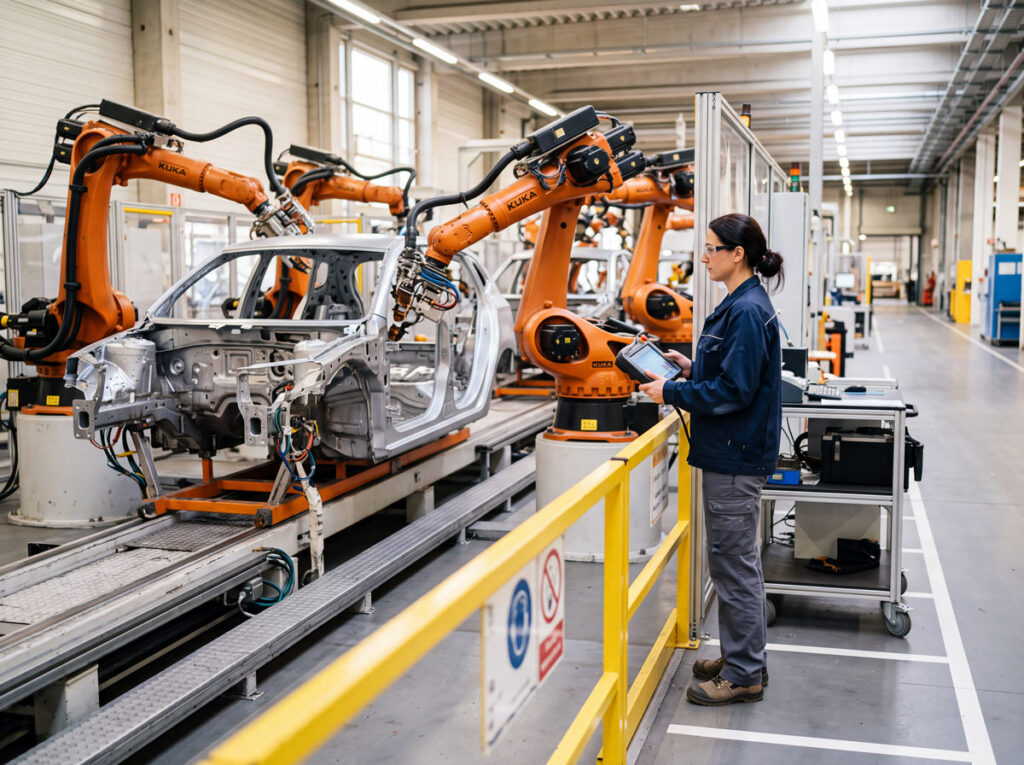
The future of work The future is shaped by artificial intelligence and increasing automation. Tasks that were performed exclusively by humans just a few years ago can now be partially or completely taken over by machines and digital systems. This quickly creates the impression that the end of work as we know it is inevitable.
This development is particularly challenging for people facing career choices or changes. Which professions still have a future? Which training programs offer long-term prospects? Is university still worthwhile? There are no simple, universally applicable answers. This is precisely why individual career coaching can provide crucial guidance.
Entire professions are not disappearing – jobs are changing.
The public debate about artificial intelligence often focuses on which jobs might disappear. However, it is more likely that the tasks within many jobs will change. This also applies to the... The Federal Employment Agency describes, that particularly simple or repetitive tasks can be automated, while new tasks and professional fields emerge.
Technological progress has always fundamentally changed job profiles. Some tasks have been automated, while new fields of activity and requirements have emerged. This process will be accelerated by AI. Many of today's professions will still be needed – albeit possibly in a different form.
Routine tasks can be increasingly automated. At the same time, skills that machines can only partially replicate are gaining in importance. These include judgment, a sense of responsibility, empathy, creativity, communication skills, and the understanding of complex relationships.
Future security, therefore, does not mean finding a job that never changes. Rather, future security lies in being willing and able to actively shape change.
Beware of supposedly safe, trendy professions
Blanket statements that a particular profession or educational path is guaranteed to be future-proof can be problematic. Markets change, technologies evolve, and even in sought-after professions, new requirements arise. Not everyone who completes a specific training program automatically finds a fulfilling and long-term successful career.
Just because a profession is generally considered to have a promising future doesn't mean it suits a person's individual interests and abilities. Those who rely solely on forecasts might choose a career path that looks attractive on paper but doesn't fulfill them personally.
Interests and skills as the basis for career choice
The most important questions regarding career orientation remain surprisingly human, even in the age of artificial intelligence:
- What topics really interest me?
- What are my personal strengths and skills?
- What activities do I enjoy?
- In which area am I willing to learn continuously?
- What working conditions fit my life and my values?
- Where do I want to take on responsibility and develop myself further?
Those who are genuinely interested in a field of work usually remain engaged with it long-term. Learning is then not just perceived as an obligation, but as part of personal development. This very willingness is becoming increasingly important in a rapidly changing world of work.
In the future, specialist knowledge alone may no longer be sufficient. Learning ability, self-reflection, and self-efficacy will be at least as important. The overview of Future Skills in BERUFENET This includes, among other things, social, personal, technological-methodological, and transformative competencies. People need to be able to recognize which skills they already possess, which of these are transferable, and which new competencies they want to develop.
Vocational training or university studies: Which is the right decision?
Whether vocational training or university studies are the better choice cannot be answered definitively. Both paths can provide a solid foundation for one's professional future. The crucial factor is how well each path suits the individual and their desired field of work.
In addition to specialized knowledge, university studies often impart analytical skills, academic writing skills, and the ability to address complex problems in a structured manner. These skills remain valuable. However, a degree alone does not guarantee job security or a successful career.
In contrast, vocational training offers a strong practical focus and allows for early entry into a specific field of work. Here, too, future viability depends on whether someone is willing to regularly expand their knowledge and meaningfully integrate new technologies into their work.
The central question is therefore not just: "Which degree is guaranteed?" More importantly: "Which educational path supports me in developing my interests and abilities in the best possible way?"„
Why individual coaching helps with orientation
Given the many possibilities and the uncertainty about future developments, professional Individual coaching It provides valuable support. It doesn't make the decision for you, but it helps you to make a well-informed and independent decision.
Coaching allows for the systematic identification of personal interests, skills, values, and goals. At the same time, career opportunities can be realistically assessed and concrete development steps planned. This results not in a one-size-fits-all career plan, but in an individualized professional perspective.
DFV Mentoring's individual coaching addresses precisely this point: it's personalized, proactive, and focused on your personal development. The emphasis isn't on finding a supposedly recession-proof career, but rather on how you can consciously utilize your strengths and develop further in a suitable professional field.
Conclusion: Future security arises from development.
The future of work will not be determined solely by artificial intelligence. It also depends on how people interact with new technologies and what tasks they perform using these tools.
Jobs will change, new roles will emerge, and some tasks will disappear. Therefore, lasting job security is offered less by a specific job title than by the ability to remain curious, to know one's own skills, and to take responsibility for personal development.
Do you want to find out which career path suits your strengths and goals? Discover our Coaching services in Berlin or Arrange a free initial consultation.
